- Published on
The Death of the Label: Generalist AI Rejects 'World Models' in Favor of First-Class Physical Foundation
One tap, and our reporting appears more often in your Google Top Stories. It makes a real difference to a small newsroom.

Supported by RoboStrategySupport for Humanoids Daily comes from RoboStrategy
Sponsored



Investing involves risk, including possible loss of principal. Read the prospectus before investing.
In the spring of 2026, the robotics industry is obsessed with the taxonomy of "world models." As labs like AMI Labs secure $1.03 billion rounds to build predictive architectures, and AGIBOT unveils scalable simulators, the terminology has become a crowded battlefield.
However, Generalist AI—the firm currently leading the charge in "from scratch" scaling—is now publicly distancing itself from the very labels it helped define. In a recent technical reflection, CEO Pete Florence argued that the current industry fixation on "World Models" and "Vision-Language-Action" (VLA) models is an "idea-driven" distraction from the ultimate goal: Physical AGI.
Beyond the "VLA Crutch"
The core of Florence’s argument is that GEN-1 is not a hybrid of existing technologies, but a "native foundation model for physical interaction." While many competitors utilize Vision-Language Models (VLMs) as a backbone—bolting robotic actions onto a brain trained on internet text—Generalist has taken the more expensive path of training approximately 99% of GEN-1’s parameters from scratch.
"GEN-1 is not a fine-tuned vision-language model... nor is it just a world model," Florence stated. He characterizes vision-language training as a "helpful crutch" that the industry leaned on because it lacked sufficient robotics data. With Generalist now sitting on over 500,000 hours of physical interaction data, Florence believes the crutch is no longer necessary. This "strong conviction" suggests that when data and compute are sufficient, models trained specifically for physics will consistently outperform those adapted from linguistic origins.
The weekly humanoid robotics briefing
One email a week: the launches, funding and research that mattered, with context from Humanoids Daily.
Read recent issuesGoal-Driven vs. Idea-Driven Research
Florence’s critique of the current World Model taxonomy draws on a framework from researcher John Schulman, distinguishing between "idea-driven" and "goal-driven" research.
- Idea-Driven: Following trends and improving upon the latest popular method (e.g., the current 2026 "World Model moment").
- Goal-Driven: Picking a concrete outcome—such as zero-shot robotics—and solving whatever technical hurdles stand in the way.
For Generalist, the goal isn't to build a "world model" for the sake of simulation; it is to achieve 99%+ success rates with only one hour of robot-specific data. This pragmatism allows the firm to pivot between architectures without being wedded to a specific academic label. "Your goals are more important than the labels on your tools," Florence noted, adding that "you don't necessarily call a rectangle a square."
Two-Handed Coordination and the "Zipper Milestone"
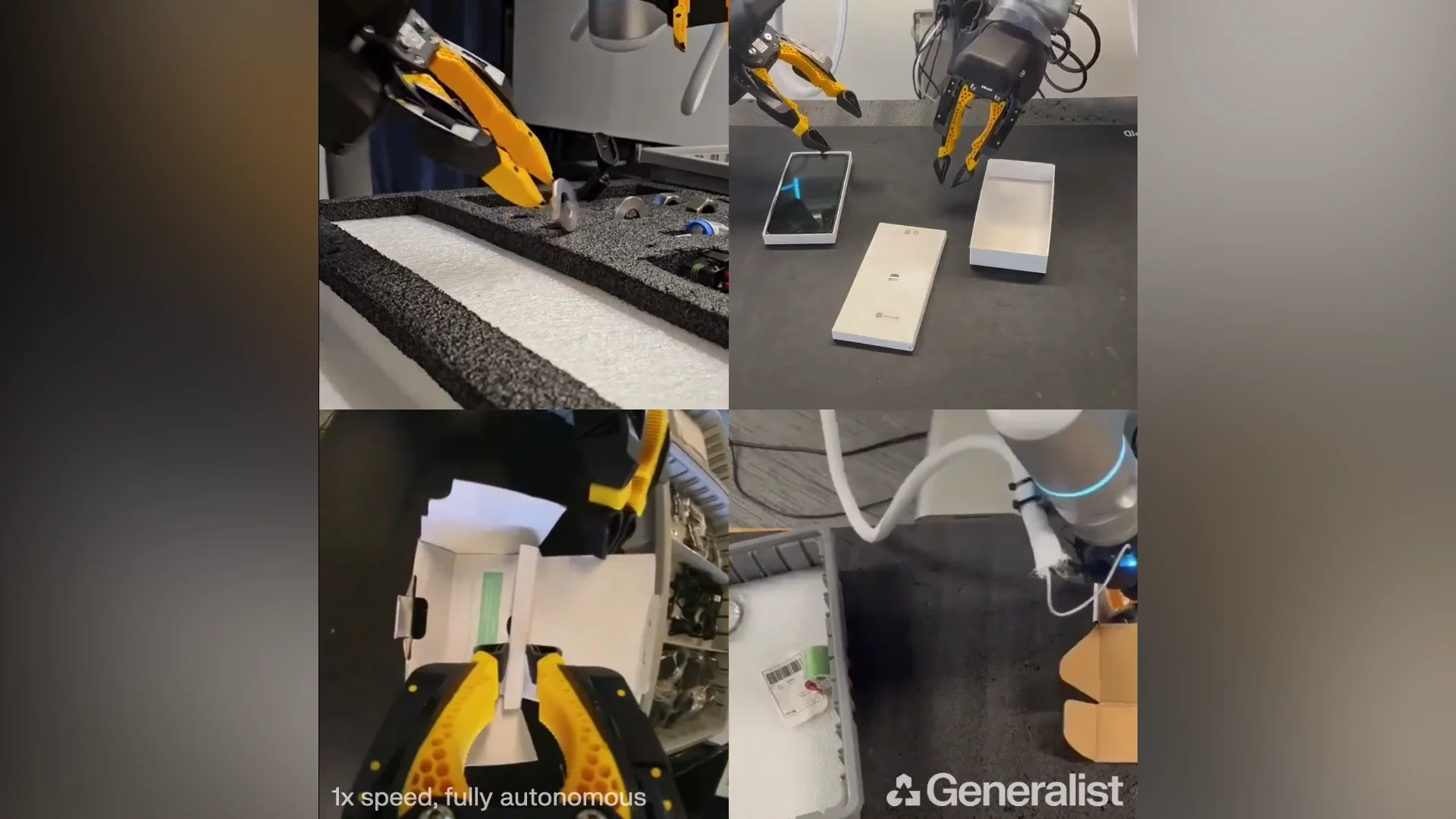
While the philosophical debate continues, Generalist is backing its "from scratch" claims with new demonstrations of dexterous manipulation. The company recently showcased GEN-1 performing a series of complex, contact-rich tasks that require the "physical commonsense" co-founder Andy Zeng has long championed:
- Two-Handed Zipping: A video showing a robot zipping a bag, a task Zeng noted was a "bummer" of a failure two years ago, now works "out-of-the-box" with GEN-1.
- iPad Interaction: A robot sorting socks while simultaneously using a touchscreen stylus to log counts on an iPad, demonstrating a blend of high-level task tracking and precise motor control.
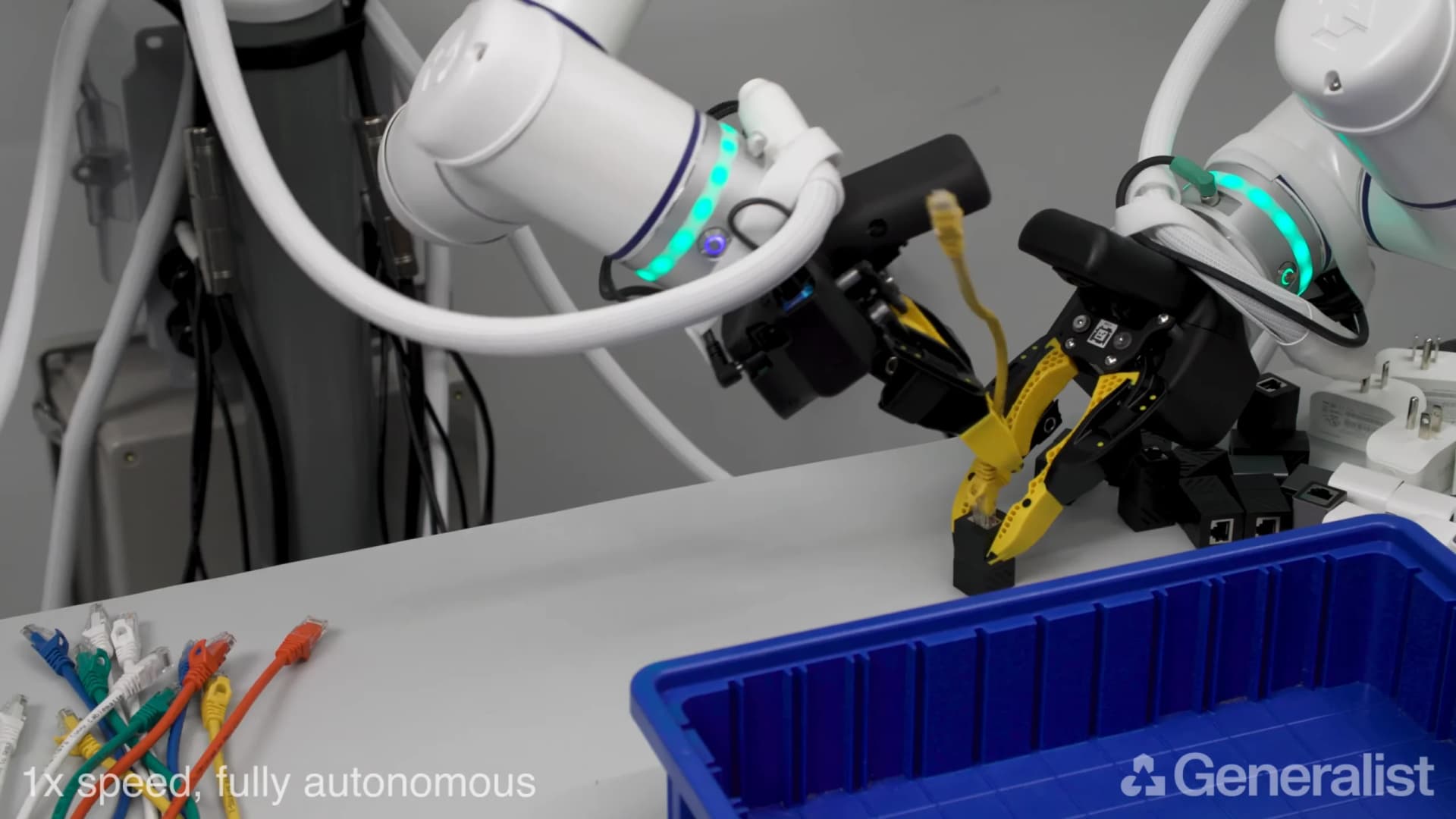
- Industrial Precision: Plugging in ethernet cables and stacking oranges, tasks that test the model's ability to handle deformable objects and narrow spatial tolerances.
The Scaling Bet
This refusal to "pick a lane" between methods like Action-Conditioning or Joint Modeling reflects a belief that the "supply side" of robotics is changing. As the data bottleneck breaks, the constraints that forced researchers into specialized "perception vs. control" silos are evaporating.
By focusing on a 7-billion parameter “intelligence threshold,” Generalist is betting that the "bitter lesson" of scaling will eventually render current architectural debates moot. If a model can internalize the laws of physics through a half-million hours of raw interaction, whether you call it a "world model" or a "foundation model" becomes a matter of semantics rather than capability.
Share this article
Read next
- Published on
- Reading time
- 5 min read
Physical AI Arms Race Accelerates: Generalist AI Secures $400M to Scale Robot Learning
- Published on
- Reading time
- 4 min read
Generalist AI Unveils GEN-1: The Quest for Robot Mastery and “Intelligent Improvisation”
- Published on
- Reading time
- 5 min read
Genesis AI Unveils Eno: The Minimalist Robot Making an "Opposite Bet" on Humanoid Design
- Published on
- Reading time
- 5 min read
Generalist AI Unveils GEN-1.5: One-Shot Robot Learning and the End of Heavy Fine-Tuning
- Published on
- Reading time
- 4 min read
The Dark Matter of Robotics: Generalist AI’s Andy Zeng on the Quest for Physical Commonsense
- Published on
- Reading time
- 4 min read
Generalist AI Releases "Science of Pretraining" Deep Dive: Why Data Quality Trumps Volume in Robotics


The weekly humanoid robotics briefing
One email a week: the launches, funding and research that mattered, with context from Humanoids Daily.
Read recent issues