- Published on
Generalist AI Unveils GEN-1: The Quest for Robot Mastery and “Intelligent Improvisation”
One tap, and our reporting appears more often in your Google Top Stories. It makes a real difference to a small newsroom.

Supported by RoboStrategySupport for Humanoids Daily comes from RoboStrategy
Sponsored



Investing involves risk, including possible loss of principal. Read the prospectus before investing.

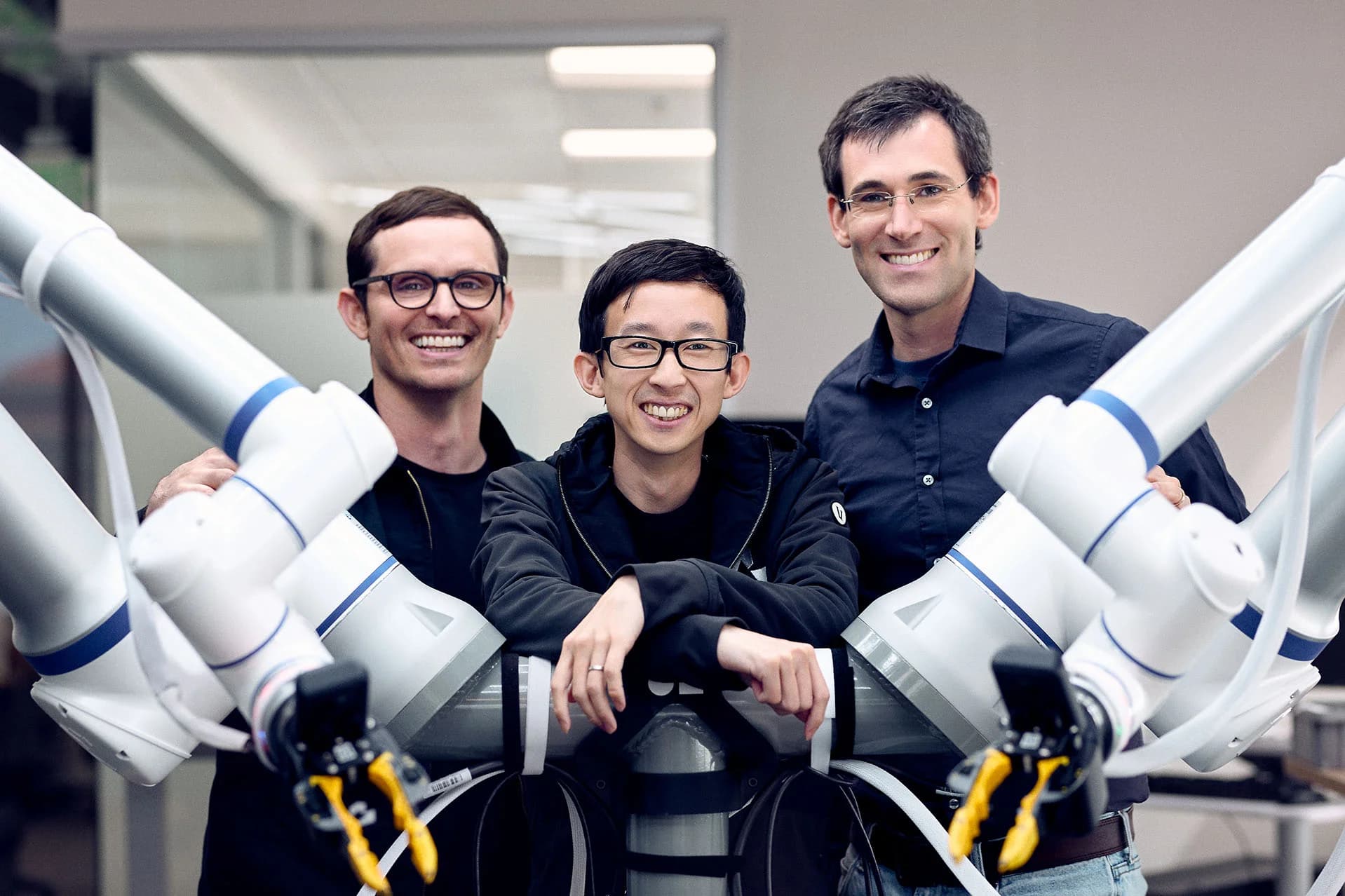
Just five months after unveiling its GEN-0 model and arguing for the existence of scaling laws in robotics, Generalist AI has announced the release of GEN-1. The new model marks a significant leap from research prototype to what the company calls "commercial viability," claiming to have mastered simple physical tasks with a level of reliability and speed that has historically eluded general-purpose AI.
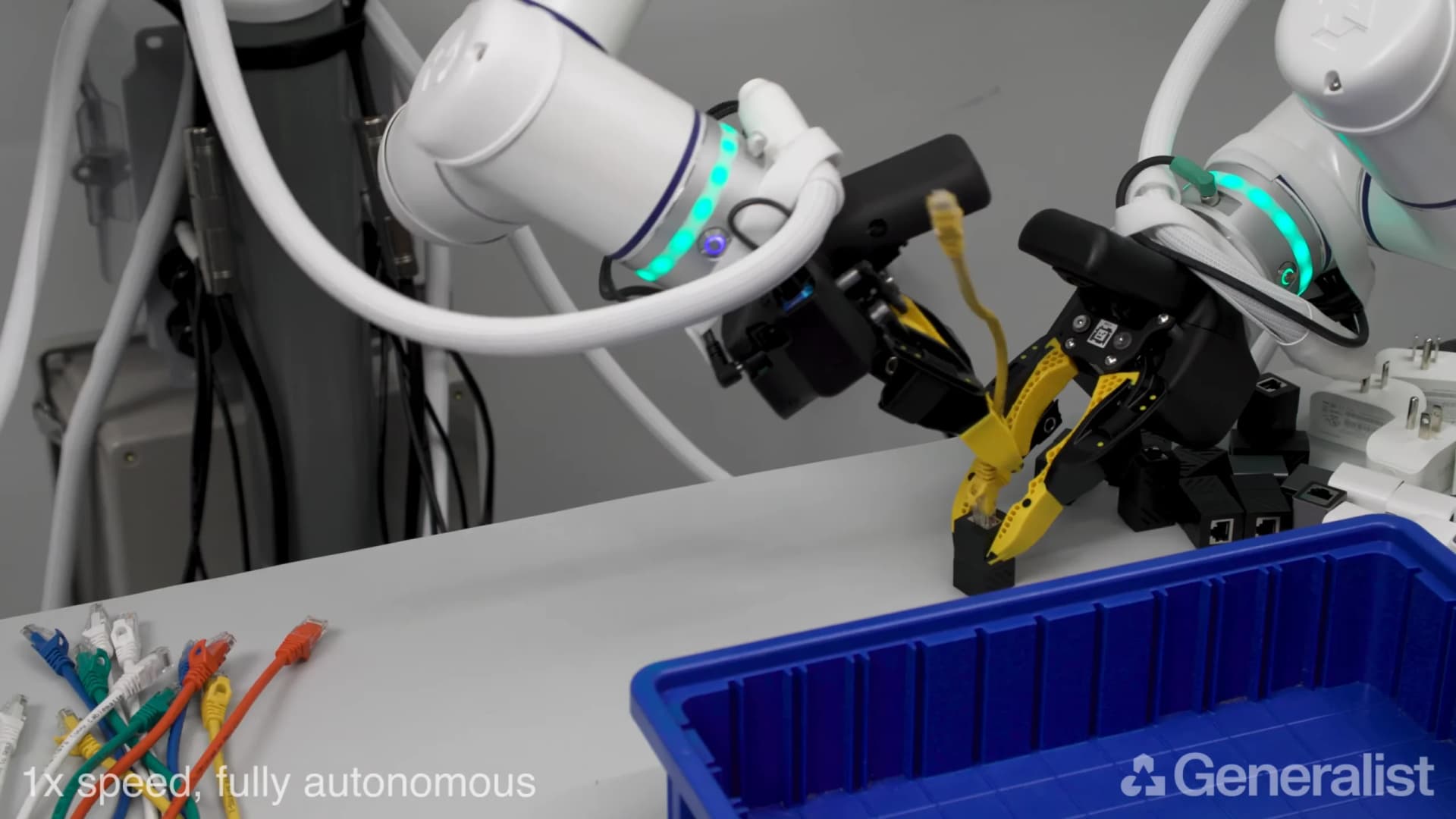
According to Generalist, GEN-1 achieves a 99% success rate on tasks where its predecessor averaged 64%, while completing those tasks roughly three times faster than current state-of-the-art systems. Perhaps most notably, the company claims these results require only one hour of robot-specific data for the model to adapt to a new task and embodiment.
Defining "Mastery" in the Physical World
Generalist’s thesis centers on a specific definition of "mastery" that combines three pillars: reliability, speed, and what CEO Pete Florence calls "intelligent improvisation."
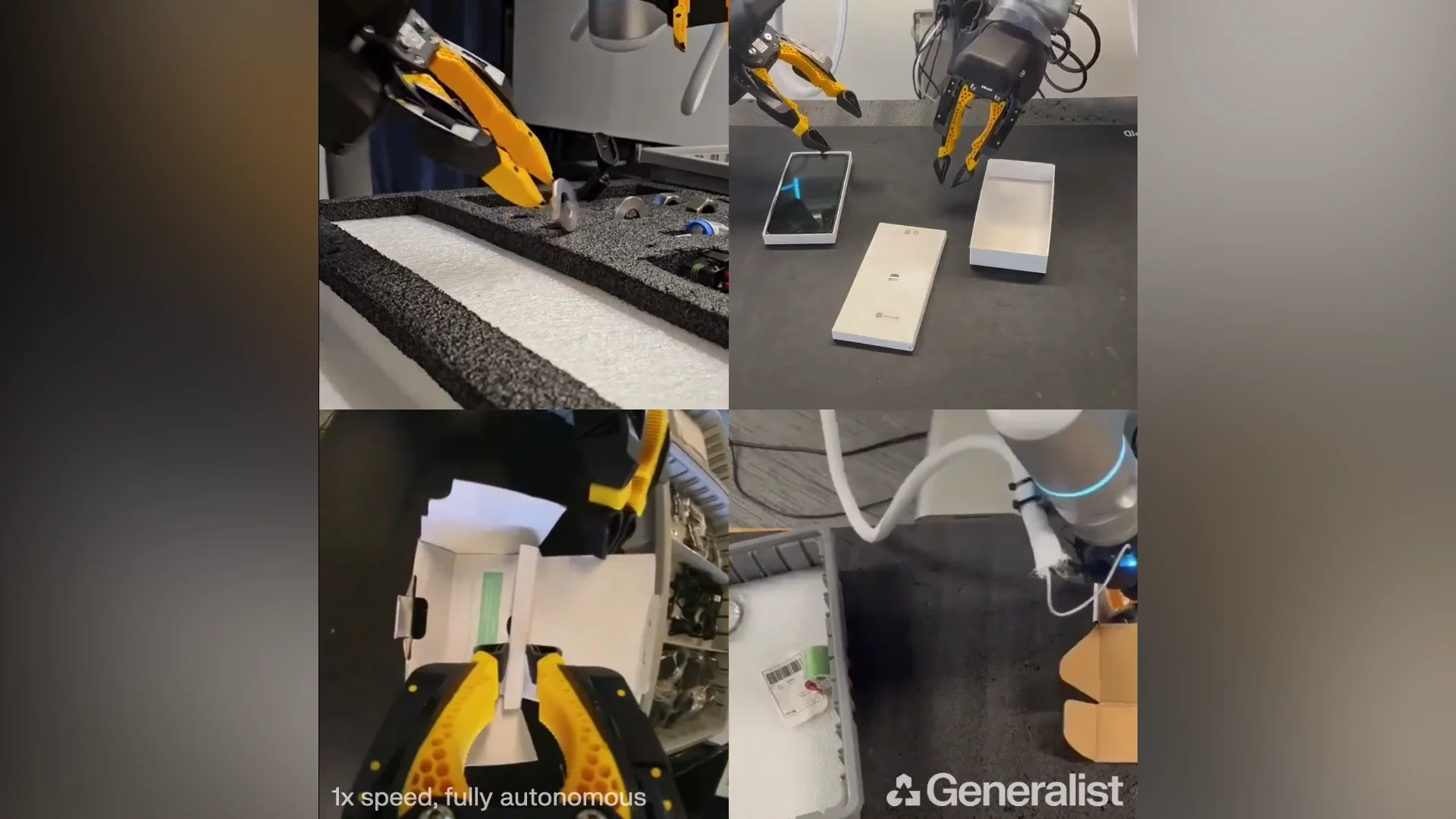
In long-running stress tests, the company demonstrated GEN-1 performing repetitive tasks for hours without human intervention. These included:
The weekly humanoid robotics briefing
One email a week: the launches, funding and research that mattered, with context from Humanoids Daily.
Read recent issues- Folding boxes 200 times in a row.
- Servicing robot vacuums over 200 times.
- Packing blocks over 1,800 times.
While industrial robots have performed repetitive motions for decades, they typically do so in "scripted" environments. GEN-1, by contrast, operates in unstructured settings where it must react to variability in real-time. This is fueled by what Generalist co-founder Andy Zeng previously described as “physical commonsense”—the reactive intuition for forces and friction that allows a machine to adjust mid-action.
The "Data Hands" Advantage
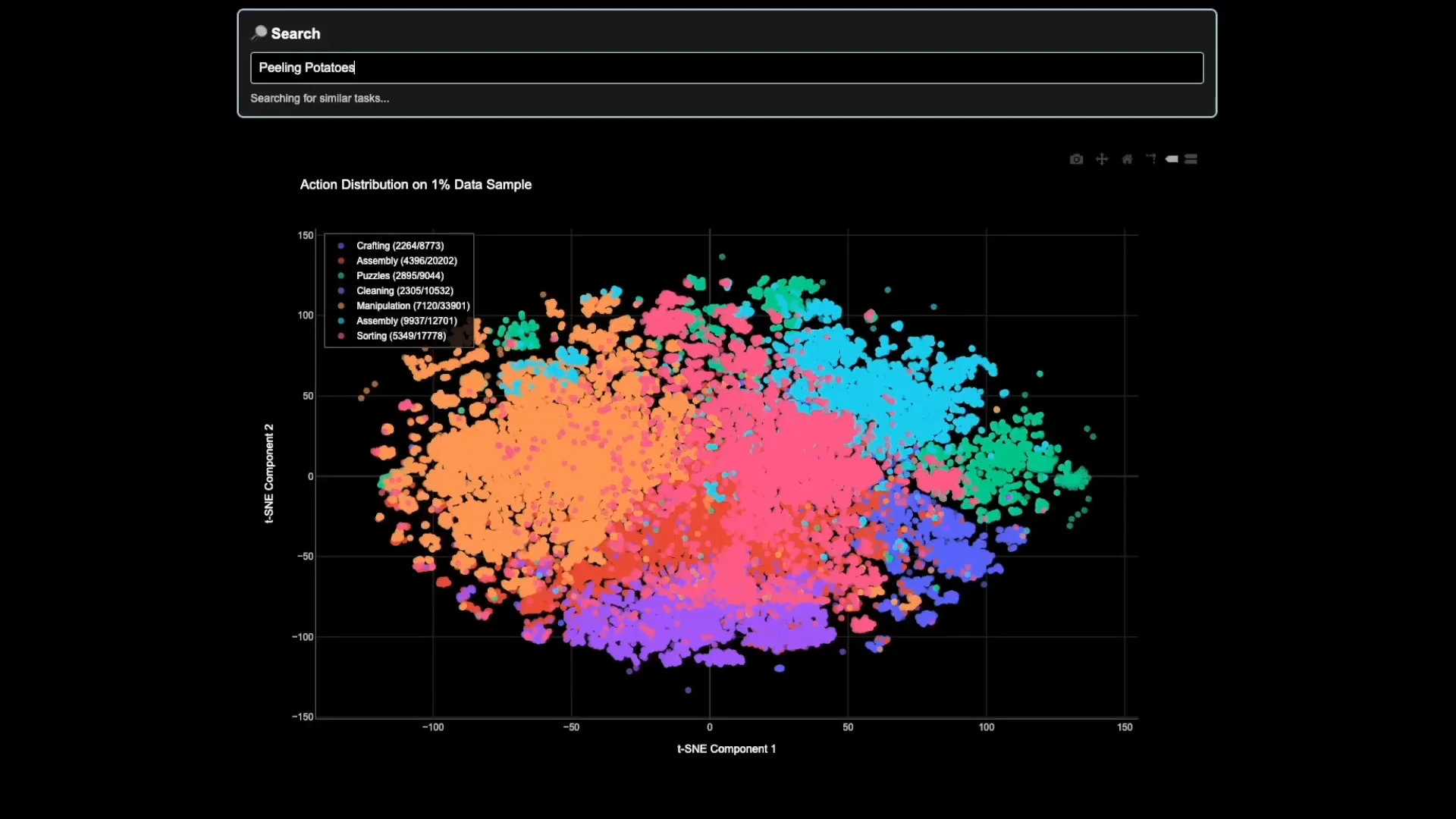
The secret sauce behind GEN-1 is a massive expansion of Generalist’s proprietary dataset, which has grown from 270,000 hours in November to over 500,000 hours of high-fidelity physical interaction data.
To bypass the industry's data bottleneck, Generalist relies on low-cost wearable "data hands"—strap-on pincer devices, or UMIs, worn by humans. This allows the company to capture human reflexes and "micro-corrections" far more efficiently than traditional, latency-prone teleoperation rigs. This is similar to the approach taken by competitors like Sunday Robotics.
The base GEN-1 foundation model is pretrained entirely on this human data; it only encounters actual robot hardware during the final hour of task-specific adaptation. This approach stands in sharp contrast to competitors like Physical Intelligence (Pi), which utilizes a hybrid of imitation and autonomous reinforcement learning in staged environments like kitchens and laundromats.
Emergent Improvisation and the "Limerick" Moment
The most compelling aspect of the GEN-1 announcement is the documentation of "emergent behaviors"—actions the robot was never explicitly trained to perform. In one instance, when a plush toy snagged while being stuffed into a bag, the robot autonomously used its secondary arm to shake the bag, allowing the toy to slide down.
"What’s happening now with robotics parallels when people opened GPT-3 and asked it to write a completely new limerick," Pete Florence told Forbes. "The limerick didn’t exist before. To achieve that, you need an improvisational level of intelligence."
This improvisation allows GEN-1 to move beyond Moravec’s Paradox, where basic physical dexterity is computationally expensive. By scaling to larger parameter counts—likely exceeding the 7-billion parameter threshold Generalist previously identified as a "phase transition" point—the model begins to internalize physical laws rather than just mimicking trajectories.
The Competitive Landscape: Scale vs. Architecture
Generalist’s release comes at a time of unprecedented investment in the sector. While Pi is reportedly raising $1 billion to build a universal "intelligence layer" for third-party hardware, Generalist is doubling down on raw physical interaction data.
However, not everyone is convinced that "scale is all you need." Critics like Brad Porter, CEO of Cobot, argue that brute-forcing data against imperfect architectures is "really expensive and not necessarily going to get you the result you want." This echoes recent skepticism from AMI Labs’ Yann LeCun, who maintains that world models must learn through observation rather than just action-token prediction.
Generalist acknowledges that GEN-1 is "far from perfect." The same emergent behaviors that allow a robot to recover from a mistake can also lead to unintended physical consequences. The company is now turning its attention to "alignment for embodied intelligence"—developing methods to steer these increasingly capable "brains" to ensure their improvisations remain helpful and safe.
GEN-1 is available today for Generalist AI’s early access partners, signaling the start of a high-stakes race to see if these models can finally leave the lab and enter the workforce.
Share this article
Read next
- Published on
- Reading time
- 5 min read
Physical AI Arms Race Accelerates: Generalist AI Secures $400M to Scale Robot Learning
- Published on
- Reading time
- 4 min read
The Death of the Label: Generalist AI Rejects 'World Models' in Favor of First-Class Physical Foundation
- Published on
- Reading time
- 5 min read
Generalist AI Unveils GEN-1.5: One-Shot Robot Learning and the End of Heavy Fine-Tuning
- Published on
- Reading time
- 5 min read
Genesis AI Unveils Eno: The Minimalist Robot Making an "Opposite Bet" on Humanoid Design
- Published on
- Reading time
- 4 min read
The Dark Matter of Robotics: Generalist AI’s Andy Zeng on the Quest for Physical Commonsense
- Published on
- Reading time
- 4 min read
Generalist AI Releases "Science of Pretraining" Deep Dive: Why Data Quality Trumps Volume in Robotics
The weekly humanoid robotics briefing
One email a week: the launches, funding and research that mattered, with context from Humanoids Daily.
Read recent issues