- Published on
Unitree Begins Open Release of UnifoLM-WLA-1.0 to Tackle Humanoid Generalization
One tap, and our reporting appears more often in your Google Top Stories. It makes a real difference to a small newsroom.

Supported by RoboStrategySupport for Humanoids Daily comes from RoboStrategy
Sponsored



Investing involves risk, including possible loss of principal. Read the prospectus before investing.

- Unitree has introduced UnifoLM-WLA-1.0, a 6-billion-parameter Vision-Language-Action (VLA) foundation model for tasks that combine seeing, understanding instructions and moving a humanoid’s body.
- The architecture pairs an embodied reasoning backbone (UnifoLM-ER-1-4B) with an MMDiT flow-based action expert trained on approximately 2,500 hours of real-world robot data, including the BitRobot-HIW-500 dataset.
- The model unifies desktop manipulation and mobile whole-body coordination into a single policy checkpoint, evaluating across 64 real-robot tasks on the Unitree G1 platform.
- The open release is happening in stages: reasoning-model weights are available, while the full WLA-Base model and post-training code remain on Unitree’s release roadmap as of September 16.
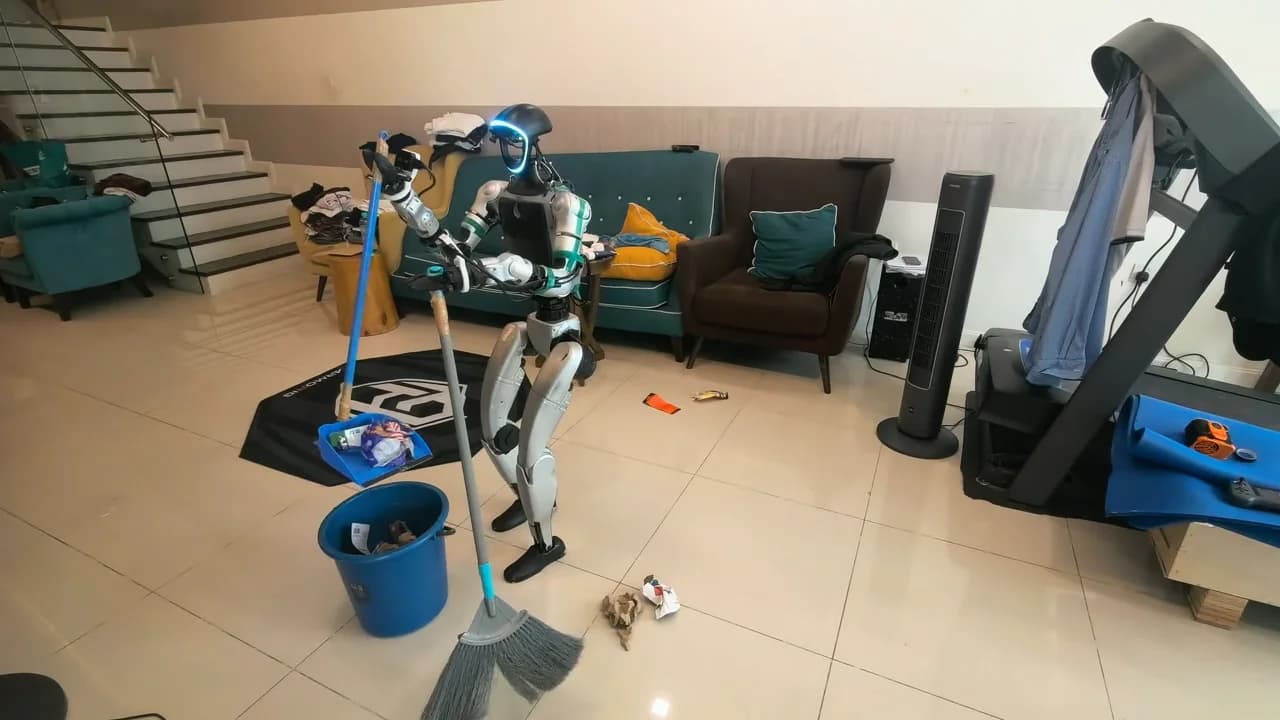
Putting laundry into a washing machine sounds mundane. For a humanoid, it means finding the clothes, grasping them, walking to the machine and coordinating both arms without losing balance. It is the kind of connected task that separates an impressive robot demonstration from useful help around a home or workplace.
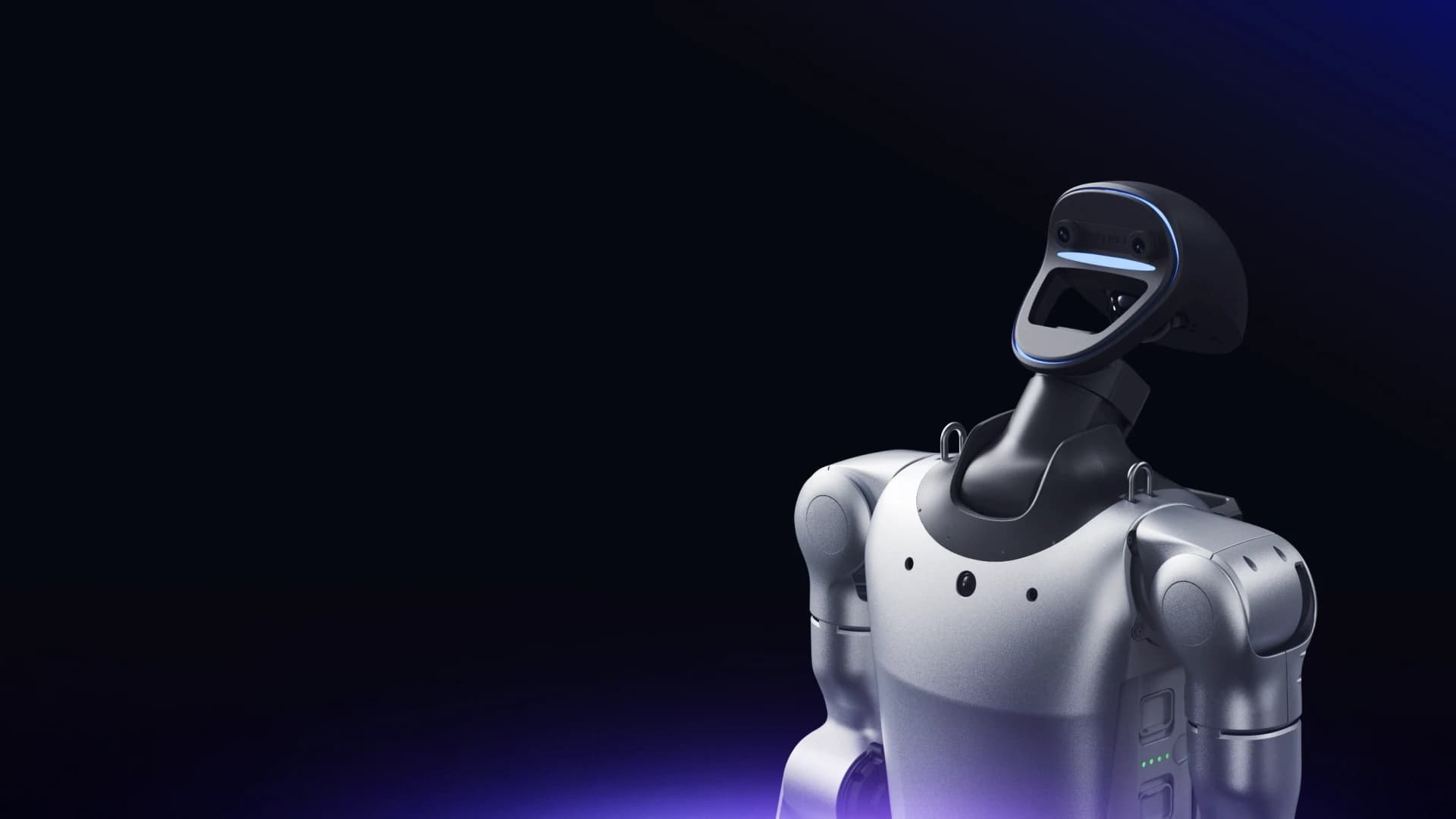
UnifoLM-WLA-1.0 is Unitree Robotics’ attempt to bring those abilities together. The model combines visual understanding, instructions and predictions about how a scene will change with actions for the robot’s hands, arms and lower body. Unitree says one model handles both tabletop tasks and work that requires the robot to move around.
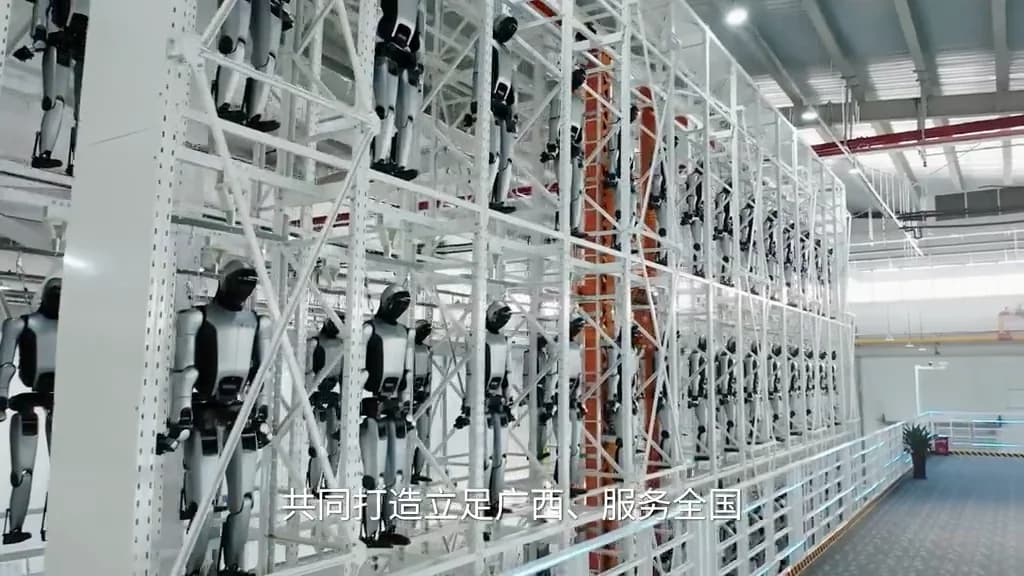
Having scaled its bipedal manufacturing lines to more than 18,000 cumulative units and staged a blockbuster public debut in Shanghai, Unitree Robotics is targeting the software bottleneck that keeps most of those machines confined to labs.
Its UnifoLM-WLA-1.0 project describes a 6-billion-parameter foundation model trained on around 2,500 hours of robot data. Unitree has begun releasing components publicly, although the complete action model and post-training code are still listed as forthcoming.
The weekly humanoid robotics briefing
One email a week: the launches, funding and research that mattered, with context from Humanoids Daily.
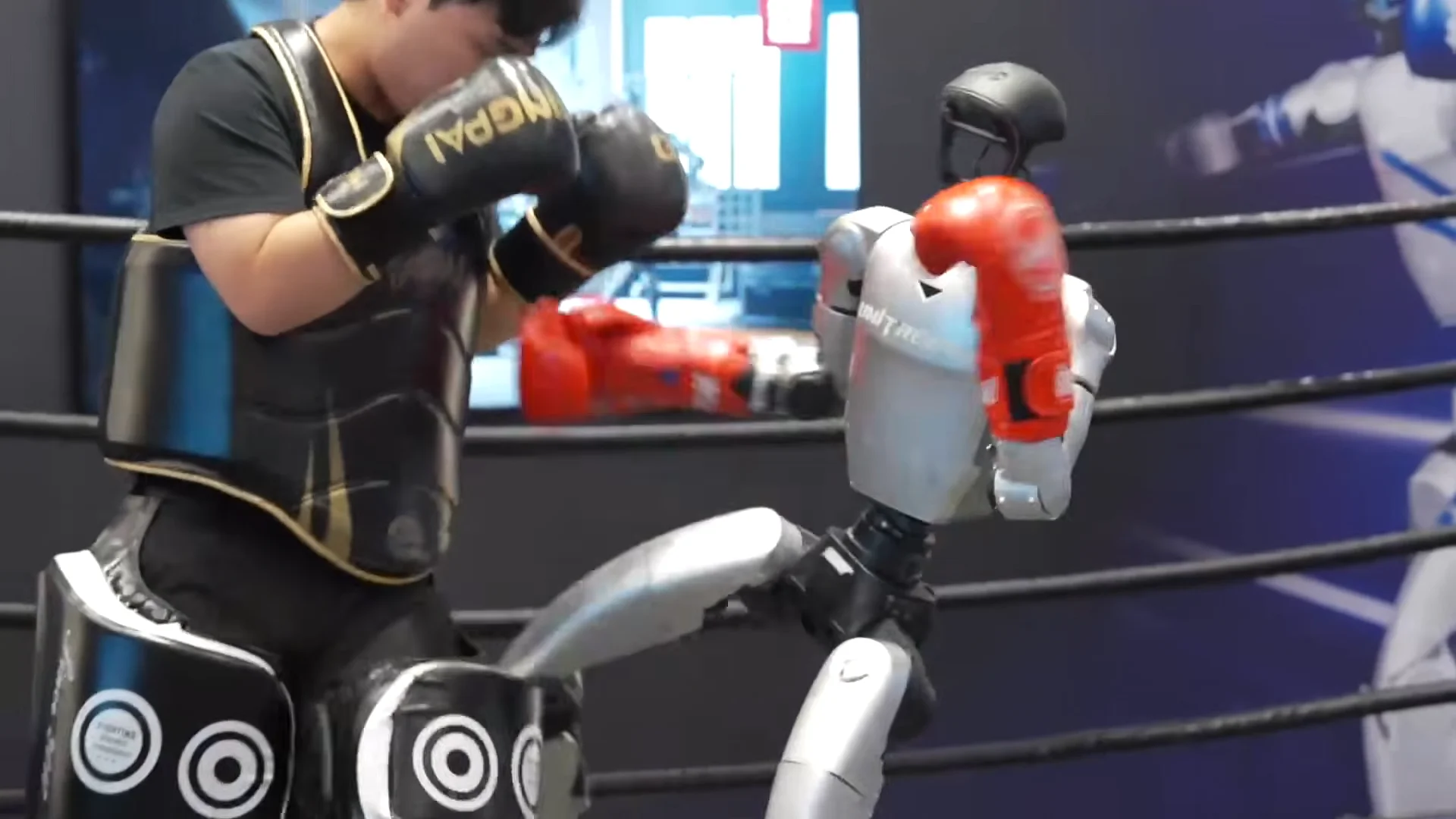
Read recent issuesThe announcement follows Unitree’s UnifoLM-X2 autonomous sparring demonstration just days earlier. The distinction is practical: X2 was showcased reacting to a human sparring partner, while WLA’s demonstrations focus on manipulating objects and coordinating whole-body tasks such as tidying and handling laundry.
What can you download now?
As of September 16, 2026, Unitree’s official GitHub release checklist separates available components from planned releases:
| Available | Still listed as forthcoming |
|---|---|
| UnifoLM-ER-1 weights | UnifoLM-WLA-Base |
| UnifoLM-ER-Flow weights | Post-training code |
| UniBot-V1 Challenge Dataset (marked released; see note below) | Unitree-WBT-Dataset and Unitree-Manipulation-Dataset |
The UniBot-V1 dataset is marked released, but its linked collection returned a missing-page error when checked.
Unitree dates the two reasoning-model weight releases to September 11. Those components let researchers examine parts of the architecture; they do not amount to a complete downloadable policy for reproducing all the robot demonstrations. The repository is the place to check as the remaining releases arrive.
Inside the UnifoLM Architecture
The architecture has three main jobs: understand the scene and the task, predict what will change during an interaction, and generate the robot’s movements. Unitree combines these within a vision-language-action system.
At its foundation sits UnifoLM-ER-1-4B, an embodied reasoner based on Qwen3-VL-4B. Co-trained on standard image-text pairs and more than 5 million embodied samples—spanning 3D bounding boxes, 2D trajectory prediction, and multi-image spatial question-answering—the model is engineered to preserve broad multimodal understanding while sharpening fine-grained physical awareness. In internal benchmark evaluations released by Unitree, the 4B parameter ER model outperformed several larger open-source baselines, including RoboBrain2.0-7B, Pelican-7B, and Cosmos-R1-7B, across tests such as Spatial-Bench, Pixmo-Point, and BLINK.
+-------------------------------------------------------------------+
|                        UnifoLM-ER-Flow                            |
|  (Multimodal Reasoning + VQ-VAE Dynamic Mask + Discretized RVQ)   |
+---------------------------------+---------------------------------+
|
v
+-----------------------------------+
|        Action Expert MMDiT        |
|           (Flow Decoder)          |
+-----------------+-----------------+
|
+---------------------+---------------------+
|                                           |
v                                           v
[Discrete Action Tokens]                  [Continuous Actions]

End-Effector Trajectories               - 10 Whole-Body Tasks

Dexterous Hand / Gripper                - 54 Tabletop Tasks

Lower-Body Locomotion
Building on the reasoning core, Unitree introduces UnifoLM-ER-Flow, which integrates interaction-centric world modeling via dynamic region prediction. The system estimates optical flow between timesteps to capture scene changes induced by physical contact, using a Vector Quantized-Variational AutoEncoder (VQ-VAE) to convert these dynamic masks into discrete tokens. When given an initial camera frame and a task prompt, the model predicts how the physical scene should mutate over future steps.
Finally, action generation is divided across a unified action space partitioned into three distinct streams: end-effector (EEF) poses, hand or gripper joints, and lower-body joints. Each component is discretized using Residual Vector Quantization (RVQ). To generate continuous trajectories, the architecture deploys an MMDiT (Multi-Modal Diffusion Transformer) flow-matching decoder, enabling the network to output smooth, high-frequency motor commands conditioned on the ER-Flow representations.
Scaling Manipulation Beyond the Bench
Unitree trained UnifoLM-WLA-1.0 on roughly 2,500 hours of real-robot demonstration data, drawing from internal datasets as well as open community repositories like BitRobot-HIW-500—the massive household teleoperation dataset hosted on Hugging Face.
Unitree evaluates the model on its G1 humanoid. According to the company’s project page, a single model handles 64 real-robot manipulation tasks without task-specific fine-tuning:
- 10 Whole-Body Manipulation Tasks: Mobile tasks requiring coordinated bipedal locomotion, torso posture adjustment, and dual-arm reach, including taking out trash, putting clothes into a washing machine, making beds, and shelving inventory.
- 54 Tabletop Manipulation Tasks: High-dexterity static operations such as folding towels, sorting small components from conveyor belts, uncapping containers, and plugging in power cords.
Crucially, the system supports both basic parallel grippers and two distinct types of multi-finger dexterous hands. Cross-end-effector generalization has historically been a significant barrier for robotics developers; swapping out a two-jaw clamp for a five-fingered hand typically breaks policy representations and requires comprehensive data recollection. By learning a shared latent representation across multiple embodiments and end-effectors, UnifoLM aims to make policy transfer far less fragile.
Open Commons in the Frontier Era
The release arrives amid an intensifying strategic debate across the embodied AI landscape. As demonstrated by recent experiments with GPT-6 Astra learning to paint in real life, frontier generalist models are increasingly proving capable of zero-shot physical planning and tool-use, leading some researchers to wonder whether specialized physical AI architectures will ultimately be swallowed by general reasoning APIs.
Yet hardware advocates argue that algorithms commoditize rapidly, leaving competitive advantages in the hands of mass-production platforms and open data flywheels. Unitree's decision to open-source UnifoLM-WLA-1.0 fits into a broader expansion of open robotics infrastructure—highlighted by NVIDIA’s $12.9 billion buyout of Hugging Face to solidify open model hosting and LeRobot community standards.
The release also addresses the sobering operational realities voiced by Unitree founder and CEO Wang Xingxing. Speaking at the World Robot Conference, Wang gave a frank assessment of why humanoids still aren't ready to scale in production environments, pointing directly to the "lossy" nature of physical contact. Unlike language models operating in lossless vector spaces, physical robots suffer from compounding millimeter-scale deviations that collapse success rates when novel environments deviate from training distributions.
Wang argued that the industry's genuine "ChatGPT moment" won't arrive until a humanoid can enter an unfamiliar room and successfully complete 80% of voice-prompted tasks—a milestone he projected was still two to ten years away.
UnifoLM-WLA-1.0 is Unitree’s attempt to accelerate that timeline through public collaboration. The components released so far give researchers a starting point, with the wider policy and training release still to come. The next test is whether the capabilities shown in Unitree’s evaluations hold up in unfamiliar homes and workplaces.
Updated September 16, 2026: Clarified the staged release and added links to the available components. An earlier version incorrectly described the full model and training recipes as already open-sourced.
Share this article
Read next
- Published on
- Reading time
- 5 min read
BitRobot and Hugging Face Drop HIW-500: A Massive 10TB Real-Home Humanoid Dataset
- Published on
- Reading time
- 6 min read
Reborn and Unitree Team Up to Accelerate Humanoid AI with Open-Source Roboverse
- Published on
- Reading time
- 7 min read
AGIBOT Open-Sources GE-Act 2.0, Challenging Unitree in the Open Embodied AI Race
- Published on
- Reading time
- 4 min read
The Synthetic Engine: How AGIBOT Genie Sim 3.0 Resolves the Embodied AI Data Bottleneck
- Published on
- Reading time
- 4 min read
120 Days to a Run: RoboParty Open-Sources Its "ROBOTO ORIGIN" Humanoid Baseline
- Published on
- Reading time
- 7 min read
Unitree’s AI models explained: UniFoLM, WLA and X2


The weekly humanoid robotics briefing
One email a week: the launches, funding and research that mattered, with context from Humanoids Daily.
Read recent issues